
Applications in the Food Industry, Hygiene Control, and Environmental Microbiological Monitoring
1. Introduction
In the food industry, microbial contamination of equipment, utensils, processing surfaces, conveyor belts, and production environments is a major concern. Such contamination can lead to cross-contamination, reduced product quality, and potential food safety risks.
Microorganisms such as Salmonella spp., Listeria monocytogenes, Escherichia coli, Staphylococcus aureus, and various hygiene indicator organisms may survive on surfaces that come into direct or indirect contact with food.
To assess the effectiveness of cleaning and disinfection procedures, food manufacturers should implement an Environmental Monitoring Program (EMP), including routine microbiological surface sampling.
Two commonly used sampling techniques are:
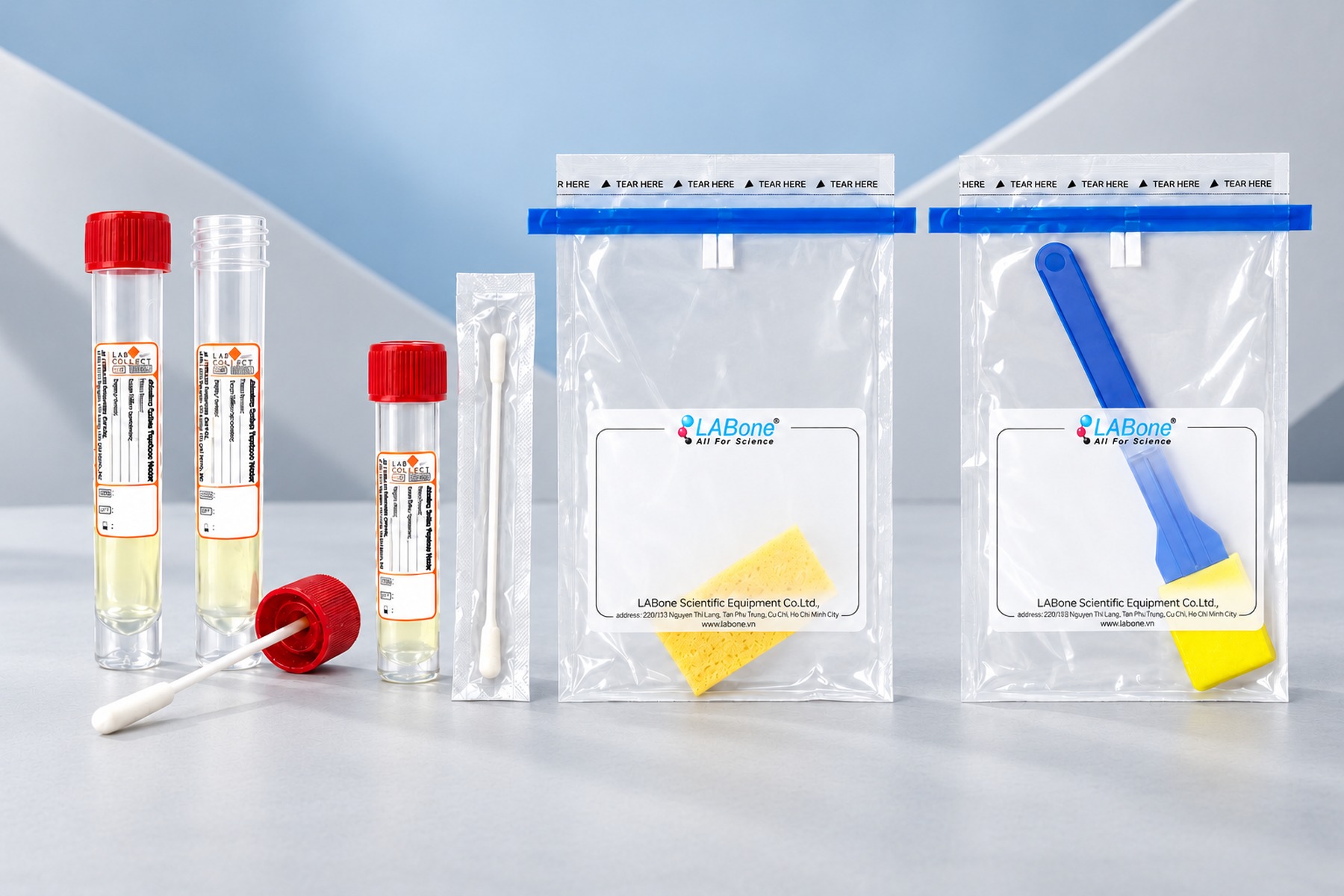
Swab Sampling: Surface sampling using sterile cotton-tipped or synthetic swabs.
Sponge Sampling: Surface sampling using sterile sponges, with or without handles.
The selection of an appropriate sampling method depends on the sampling area, surface characteristics, target microorganisms, and analytical objectives.
2. Applicable ISO Standards
Several international standards provide guidance on microbiological surface sampling and subsequent laboratory analysis.
ISO 18593:2018 is the primary reference standard for microbiological surface sampling in food production environments.
It provides guidance on surface sampling techniques, while subsequent microbiological testing must follow the appropriate analytical standards for the target microorganisms.
3. Surface Sampling Using Sterile Swabs
3.1. Principle
Swab sampling involves using a sterile cotton-tipped or synthetic swab, usually moistened with a suitable sterile solution, to recover microorganisms from a defined surface.
After sampling, the swab is transferred into a sterile tube containing an appropriate transport solution, diluent, or microbiological medium for further laboratory analysis.
3.2. Applications
Swab sampling is particularly suitable for small surfaces, hard-to-reach locations, and equipment with complex geometries, including:
Valves, joints, filling nozzles, and connectors.
Crevices, welds, and inaccessible equipment corners.
Cutting tools, processing utensils, and food-contact surfaces.
Door handles, control buttons, and frequently touched surfaces.
Locations suspected of retaining microbial contamination after cleaning.
3.3. Sampling Procedure
Step 1 – Preparation
Prepare sterile swabs, an appropriate moistening or neutralizing solution, sterile sample tubes, clean gloves, and a sterile sampling template where required.
Step 2 – Selection of Sampling Area
For flat surfaces, a sterile template may be used to define the sampling area.
For example, a 10 × 10 cm template represents a sampling area of 100 cm².
The actual sampling area should be selected according to the monitoring objectives and the established sampling procedure.
Step 3 – Moistening the Swab
If a dry swab is used, moisten the swab tip with a suitable sterile solution.
Where residual disinfectants may be present, an appropriate neutralizing solution should be selected and verified for its intended application.
Step 4 – Microbial Recovery
Wipe the swab across the entire sampling area using horizontal and vertical strokes.
Rotate the swab tip during sampling to maximize contact with the surface.
Apply consistent pressure without damaging the swab or introducing contamination.
Step 5 – Sample Storage and Transportation
Place the swab into the sterile sample tube, close it securely, and record the sample identification, location, sampled area, sampling time, and operator.
Transport the sample under the temperature and time conditions specified by the applicable analytical method or validated laboratory procedure.
Avoid freezing unless explicitly permitted by the method.
4. Surface Sampling Using Sterile Sponges
4.1. Principle
Sponge sampling uses a sterile sponge, generally pre-moistened with a suitable buffer or neutralizing solution, to recover microorganisms from relatively large surface areas.
Compared with conventional swabs, sponges provide a larger contact area and are convenient for sampling extensive or irregular surfaces.
4.2. Applications
Sponge sampling is widely used for:
Food processing conveyor belts.
Stainless steel worktables and equipment surfaces.
Cutting, mixing, and packaging machinery.
Meat, seafood, and ready-to-eat food processing environments.
Beef and pork carcass surfaces and other applications covered by suitable carcass sampling methods.
Floors, drains, and other non-food-contact environmental monitoring locations.
4.3. Sampling Procedure
Step 1 – Sponge Preparation
Use a sterile pre-moistened sponge or moisten a sterile dry sponge with an appropriate solution.
A sponge attached to a handle may help minimize direct handling and reduce the risk of contamination.
Step 2 – Sampling Area Selection
Depending on the environmental monitoring program, sampling areas may include 100 cm², 400 cm², or larger areas when appropriate and specified in the sampling SOP.
Step 3 – Surface Sampling
Wipe the sponge over the selected surface using horizontal strokes, followed by vertical strokes.
Different sides of the sponge may be used according to the validated sampling procedure to improve microbial recovery.
Step 4 – Sample Collection
Place the sponge into a sterile sampling bag, avoiding contact between the sampled surface and hands, the outside of the bag, or other non-sterile objects.
Step 5 – Transportation and Analysis
Seal and label the sampling bag.
Transport the sample to the laboratory under appropriate conditions and process it according to the selected microbiological test method.
For pathogen detection, samples generally undergo an appropriate enrichment procedure before isolation and confirmation.
5. Comparison Between Swab and Sponge Sampling
Microbial recovery efficiency depends not only on the sampling device but also on the surface material, moisture, sampling solution, wiping pressure, transportation conditions, and analytical method.
6. Selection of Sampling and Neutralizing Solutions
The selection of an appropriate sampling solution is a critical factor in microbiological surface monitoring.
Not all solutions are suitable for every microorganism or disinfectant.
Residual disinfectants may continue to inhibit microorganisms after sample collection if they are not adequately neutralized.
This can result in underestimated microbial counts or false-negative results.
Therefore, the effectiveness and non-toxicity of the selected neutralizing solution should be evaluated for the intended application.
7. Applications in the Food Industry
7.1. Meat and Poultry Processing Plants
In slaughterhouses and meat processing facilities, microbial cross-contamination may occur on carcasses, cutting tools, processing tables, conveyor belts, and production equipment.
Common microbiological targets include:
Total aerobic microbial count.
Enterobacteriaceae.
Escherichia coli.
Salmonella spp.
Listeria monocytogenes in relevant risk-based monitoring locations.
ISO 17604 provides microbiological carcass sampling methods, including destructive and non-destructive techniques.
The selection of sampling sites, sampling areas, and the number of samples should consider carcass type, monitoring objectives, and applicable regulatory requirements.
7.2. Seafood Processing Facilities
In shrimp, fish, and frozen seafood processing plants, swabs and sponges can be used to monitor:
Preparation and processing tables.
Sorting and grading equipment.
Conveyor belts.
Freezing equipment.
Packaging machinery.
Microbiological targets should be selected based on the hazard analysis of each production process and may include hygiene indicator organisms, Salmonella, or Listeria.
7.3. Dairy and Ready-to-Eat Food Manufacturing
In ready-to-eat (RTE) food production, environmental monitoring for Listeria spp. and Listeria monocytogenes is particularly important.
These microorganisms may persist in moist environments, equipment joints, drains, and areas that are difficult to clean.
High-priority monitoring locations may include:
Equipment downstream of heat treatment.
Finished-product conveyor belts.
Packaging areas.
Floor drains.
Areas susceptible to biofilm formation.
A risk-based environmental monitoring program helps identify potential contamination sources before they affect finished products.
7.4. Environmental Hygiene Monitoring
Food processing facilities may organize environmental sampling into four monitoring zones:
Zone 1 – Direct Food-Contact Surfaces
Surfaces that directly contact food, such as cutting blades, conveyor belts, and filling equipment.
Zone 2 – Areas Adjacent to Food-Contact Surfaces
Equipment frames, control panels, and nearby surfaces that may indirectly contribute to contamination.
Zone 3 – Non-Food-Contact Surfaces Within Processing Areas
Floors, drains, walls, and other surfaces within the processing environment.
Zone 4 – Areas Outside the Immediate Processing Environment
Corridors, changing rooms, and other supporting areas.
This zoning approach supports risk-based sampling plans, appropriate sampling frequencies, and effective corrective actions.
8. Evaluation and Interpretation of Results
For quantitative microbiological analysis, results may be expressed as colony-forming units per square centimeter (CFU/cm²), provided that the sampled area is known and the analytical method supports quantitative reporting.
The general calculation is:
N (CFU/cm²) = C × V × D / A
Where:
N: Microbial density on the sampled surface.
C: Calculated microbial concentration in the sample suspension (CFU/mL).
V: Total volume of the sample suspension (mL).
D: Additional dilution factor, if not already incorporated into C.
A: Sampled surface area (cm²).
For qualitative pathogen detection, results are generally reported as detected or not detected in the sampled area or sample unit.
There is no single universal CFU/cm² acceptance limit applicable to all food production environments.
Alert and action limits should be established based on risk assessment, historical monitoring data, customer requirements, and applicable regulatory criteria.
9. Critical Factors Affecting Sampling Quality
To ensure representative and reliable microbiological results, the following factors should be controlled:
Sterility of sampling devices.
Sampling location and surface area.
Selection of moistening or neutralizing solutions.
Sampling technique and wiping pressure.
Sampling time relative to cleaning and disinfection.
Transportation time and temperature.
Microbial recovery characteristics of different surface materials.
Sample identification, traceability, and storage conditions.
Sampling performed immediately after cleaning is primarily intended to verify hygiene effectiveness.
Sampling during production may provide additional information on microbial contamination risks under actual operating conditions.
Both approaches can contribute to a comprehensive environmental monitoring program.
10. LABone Solutions for Microbiological Surface Sampling
LABone develops and supplies microbiological sampling, transportation, and testing solutions for the food industry and environmental hygiene monitoring.
Our product portfolio supports different stages of the microbiological testing workflow.
Sterile Swab Sampling
Sterile sampling swabs designed for small surfaces, difficult-to-access locations, and routine hygiene monitoring.
Sterile Sponge Sampling
Sterile sampling sponges, including configurations with handles, suitable for large-area surface sampling, processing equipment, and environmental monitoring programs.
Sampling and Transport Solutions
Sterile sampling tubes and bags, combined with suitable buffering or neutralizing solutions according to the intended microbiological application.
Ready-to-Use Microbiology Media
Ready-to-use microbiological culture media and solutions supporting sample preparation, enrichment, isolation, enumeration, and quality control.
LABone is committed to providing integrated microbiological solutions covering:
Sampling → Transportation → Sample Preparation → Cultivation → Analysis → Quality Control
Our solutions support food manufacturers and testing laboratories in implementing consistent and reliable microbiological monitoring programs.
11. Conclusion
Microbiological surface sampling using sterile swabs and sponges is an essential component of hygiene monitoring and food safety management.
Swab sampling is particularly useful for small surfaces and complex equipment structures, while sponge sampling is well suited for larger areas and environmental pathogen monitoring.
The application of ISO 18593, together with appropriate microbiological analytical standards, suitable sampling devices, and controlled transportation conditions, contributes to reliable test results.
An effective environmental monitoring program enables food manufacturers to verify cleaning effectiveness, identify contamination risks, and strengthen preventive food safety controls.
LABone – Advancing Microbiology Solutions.